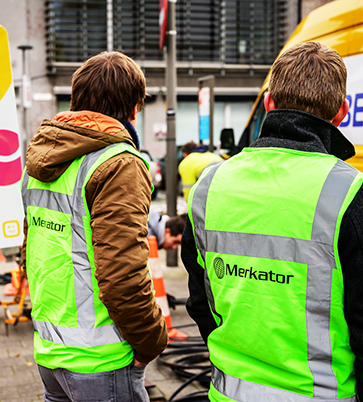
Use case – Proximus and Merkator Group: building the backbone of Belgian fiber together
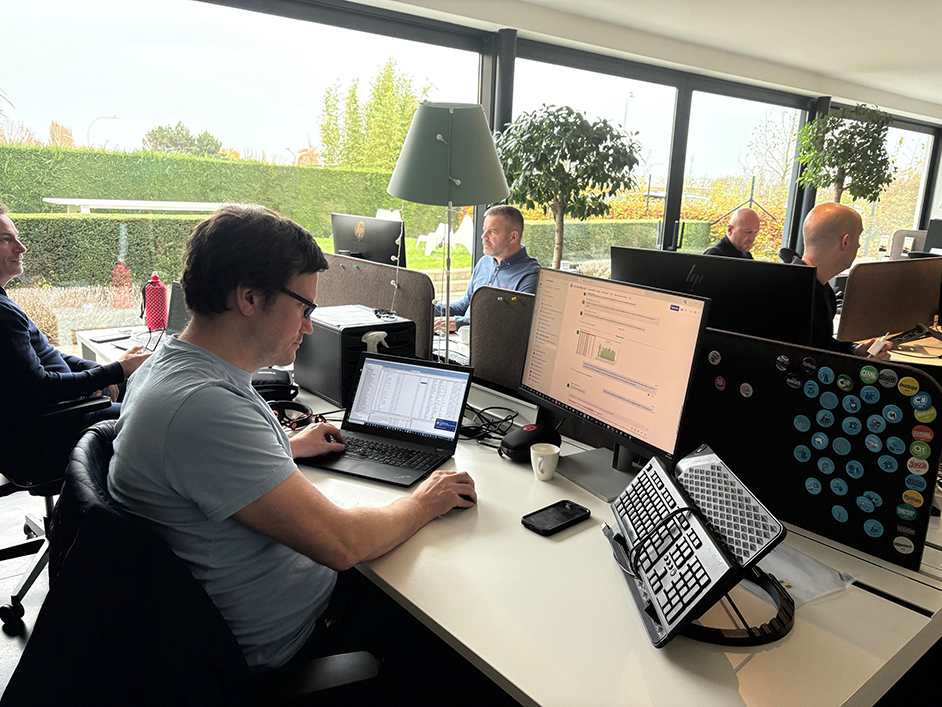

A strategic partnership since 2012
The close collaboration between Proximus and Merkator dates back to 2012. Even then, Proximus had ambitious plans: a large-scale rollout of a fiber-to-the-home (FTTH) network across Belgium.
Up until that point, fiber usually only reached as far as the street cabinet. The ‘last mile’ to the customer was covered by copper wire—a technology that served well for years, but could no longer support the explosive growth in data traffic.
Fiber is the technology of the future: not only for home connections, but also as an essential backbone for 5G—and eventually 6G—networks. Rolling out such critical infrastructure requires precise planning and flawless documentation of how everything is ultimately installed: the so-called as-built registration.
Up until that point, fiber usually only reached as far as the street cabinet. The ‘last mile’ to the customer was covered by copper wire—a technology that served well for years, but could no longer support the explosive growth in data traffic.
Fiber is the technology of the future: not only for home connections, but also as an essential backbone for 5G—and eventually 6G—networks. Rolling out such critical infrastructure requires precise planning and flawless documentation of how everything is ultimately installed: the so-called as-built registration.
Merkator Group as geospatial partner for critical network data
With years of geo-ICT expertise in the utilities and telecom sector, Merkator was able to support Proximus from day one.
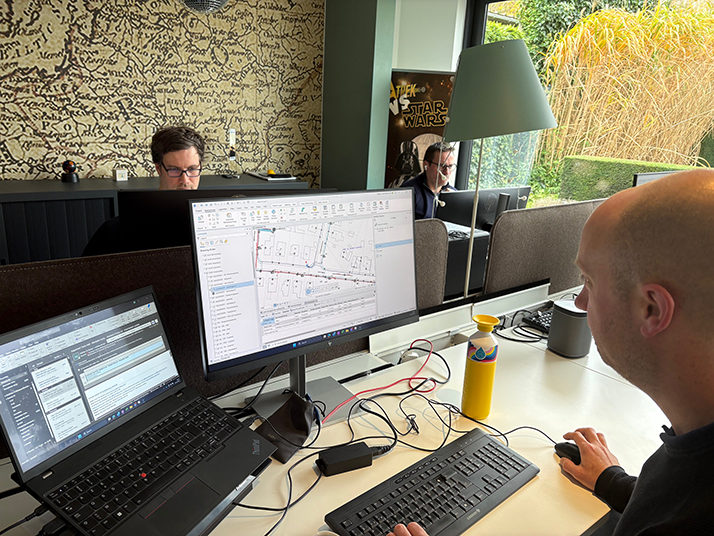
As of 2025, a team of 25 experts from Proximus, Merkator, and Hexagon is responsible for the tools that form the foundation for accurate registration, documentation, and reporting of all planned and installed pipelines, cables, manholes, splitters, and other network components.
As of 2025, a team of 25 experts from Proximus, Merkator, and Hexagon is responsible for the tools that form the foundation for accurate registration, documentation, and reporting of all planned and installed pipelines, cables, manholes, splitters, and other network components.
The key success factors are:
- A customer-focused approach and close collaboration with Proximus teams
- Deep domain knowledge of telecom networks
- Internal training and knowledge sharing between developers and analysts

Complex technology, made manageable
In addition to domain knowledge, Merkator also brings the necessary technological expertise. The teams work daily with tools such as:
- Hexagon Networks (formerly G/Technology)
- C# .NET
- Oracle PL/SQL
- FME
These are powerful, but not always easy-to-manage software platforms. Moreover, a large-scale program like the fiber rollout requires more than just development:
- Architecture and solution design
- Testing and quality assurance
- Release management
- Scrum masters and team coordination
Merkator provides talent and expertise across the entire value chain.
.

A multi-year data migration as the foundation
The fiber rollout takes place in multiple phases. In the first crucial phase, all data is migrated from the existing fiber access network, which connects various central offices and street distribution points.
Data is transferred from Alcatel NIMS to Hexagon Networks. This is a complex, multi-year data migration involving:
Data is transferred from Alcatel NIMS to Hexagon Networks. This is a complex, multi-year data migration involving:
- Functional customizations
- Data quality corrections
- Transformations and intermediate migration steps
The goal: a seamless, error-free, and gradual transformation process with no impact on operational activities.
New partnerships, shared infrastructure
To further accelerate the fiber rollout and avoid duplicate installations, Proximus is forming new partnerships with organizations such as Telenet, Wyre, and Fiberklaar.
Here too, data exchange is crucial, and once again, Merkator staff play a key role in designing, implementing, and ensuring the quality of these information flows.

Smart automation of FTTH documentation
Proximus aims to automate FTTH rollout documentation as much as possible. This not only speeds up data entry but also reduces the risk of human error.
With just a few clicks, entire subnetworks can be mapped, including:
With just a few clicks, entire subnetworks can be mapped, including:
- Pipelines and cables
- Distribution boxes and splitters
- All fiber connections (fusion splices and connectors) down to the fiber level
Throughout the rollout, multiple network technologies are introduced. Proximus adapts dynamically to changing cost rates and the latest technologies. This leads to new network topologies, such as:
- The evolution from point-to-multipoint to point-to-point
- New types of fiber nodes (SuberBAC, Points of Presence, POP containers)
The technical toolset evolves alongside these changes and is continuously refined by Proximus engineers, implemented and maintained by Merkator staff, in close collaboration with colleagues from DxC and Hexagon Belgium.
Integrations, reporting, and collaboration with partners
A well-oiled process requires more than just good tools. There is a need for:
- Automated reporting
- Data exchange with internal backend systems, such as provisioning (customer connections)
- Streamlined communication with numerous external partners, including:
- Go4Fiber
- Fifthnet
- Go-Fiber (Glasfiber Ostbelgien)
- Fiberklaar (now part of the Proximus Group)
Merkator plays a central role in setting up and maintaining these data flows.

Belmap and Location Master: one reliable address foundation
Accurate and systematic documentation of both new fiber and existing copper customer connections requires a robust address database.
Proximus found this in Belmap, a data product from GIM (now part of the Merkator Group). Belmap:
Proximus found this in Belmap, a data product from GIM (now part of the Merkator Group). Belmap:
- Intelligently combines multiple address sources
- Provides stable address IDs
- Enriches addresses with thematic data (number of floors, roof types, building height, etc.)
- Integrates geographic information such as new subdivisions
- Undergoes rigorous quality control
Based on Belmap, Proximus is building an innovative central address management system: Location Master (LOM). This will become the company-wide backbone for all address information.
The address register is continuously updated and improved with:
The address register is continuously updated and improved with:
- External data from Belmap
- Internal feedback from building and street inventories as part of the fiber rollout
The result is a win-win partnership: Proximus has a reliable, centralized address foundation, while the Belmap data is continuously refined.