A connection is down.
Can you find the fault before the truck rolls?

Join our new MarlinDT webinar on 30 June — a quick tour through a real root-cause analysis, from the POP to the customer, OSP to ISP, splice to patch. Live, in English and French, with the recording sent to everyone who registers.
Published at 25 June 2026 door Liesbeth De Ryck

A customer calls. Their connection is down. The clock starts.

To dispatch the right team to the right manhole — not three of them to the wrong ones — you need to answer a deceptively simple question fast: where exactly is the fault? 

And the honest answer depends entirely on the state of your network inventory. Is it accurate? Complete? Up to date? Or does the truth live half in GIS, half in spreadsheets, with a CAD export and a couple of PDFs filling the gaps?

Tuesday 30 June

That scenario is the spine of a new webinar for MarlinDT, the digital twin for telecom and utility networks built by Merkator Group on Esri ArcGIS.

We’re running it live on Tuesday 30 June — and if you can’t make it, register anyway and we’ll send you the recording.

Secure your spot today

It’s a short, practical tour — not a slideware pitch.

Luc De Heyn (CCO, Merkator) opens with who we are and where MarlinDT is heading, 

Wouter Deleu (Customer Success Manager, MarlinDT) takes over for the product walkthrough.

What you'll see in the tour?

We start from a real operational situation — a customer's connection is down — and work the root cause the way an operator actually would, using an OTDR measurement to pinpoint the exact fault location before anyone is dispatched. Along the way we move:


From the POP all the way to the customer
OSP and ISP, including the patching and splicing
MarlinDT Web and MarlinDT Desktop on ArcGIS Pro, so you can see how the field and the design office work off the same single source of truth.

Content

We’ll also show you something small that tends to land hard with practitioners:
  • the front panel of the patch panel the thing that usually lives in a forgotten side-spreadsheet, gradually drifting out of sync — modelled directly inside MarlinDT in ArcGIS.
  • It’s a minor feature on paper, but it’s exactly the kind of detail that decides whether your inventory is trustworthy or not.
The point is what makes that trace actionable in seconds: one accurate, complete, up-to-date inventory of the physical network, instead of fault-finding stitched together across disconnected systems.

Q&A

We close with a short Q&A on two themes that come up in almost every conversation we have — logical network inventory (mining the active network instead of relying on manual entry) and data migration (getting your existing data in, cleanly). We keep those answers deliberately brief, because the useful version of that discussion is the one we have with you about your network — not a generic one.

Who it's for

From field operations to network design and GIS, discover how a single source of truth connects every team.

NOC and operations
teams who live with
time-to-repair

Design and engineering
teams who care about splicing plans

BoM/BoQ and as-built
accuracy

GIS and IT people
who want to know how
this fits an existing Esri estate

A quick reminder of where this comes from

Merkator Group is a European geospatial software, data and services provider with 1,000+ customers, an Esri Gold and FME Gold partnership, and ISO 9001 and 27001 certification.

MarlinDT is our network-inventory platform — and the foundation for the autonomous, digital-twin networks our customers are building toward.

And let’s continue in person. 

We’ll be at the

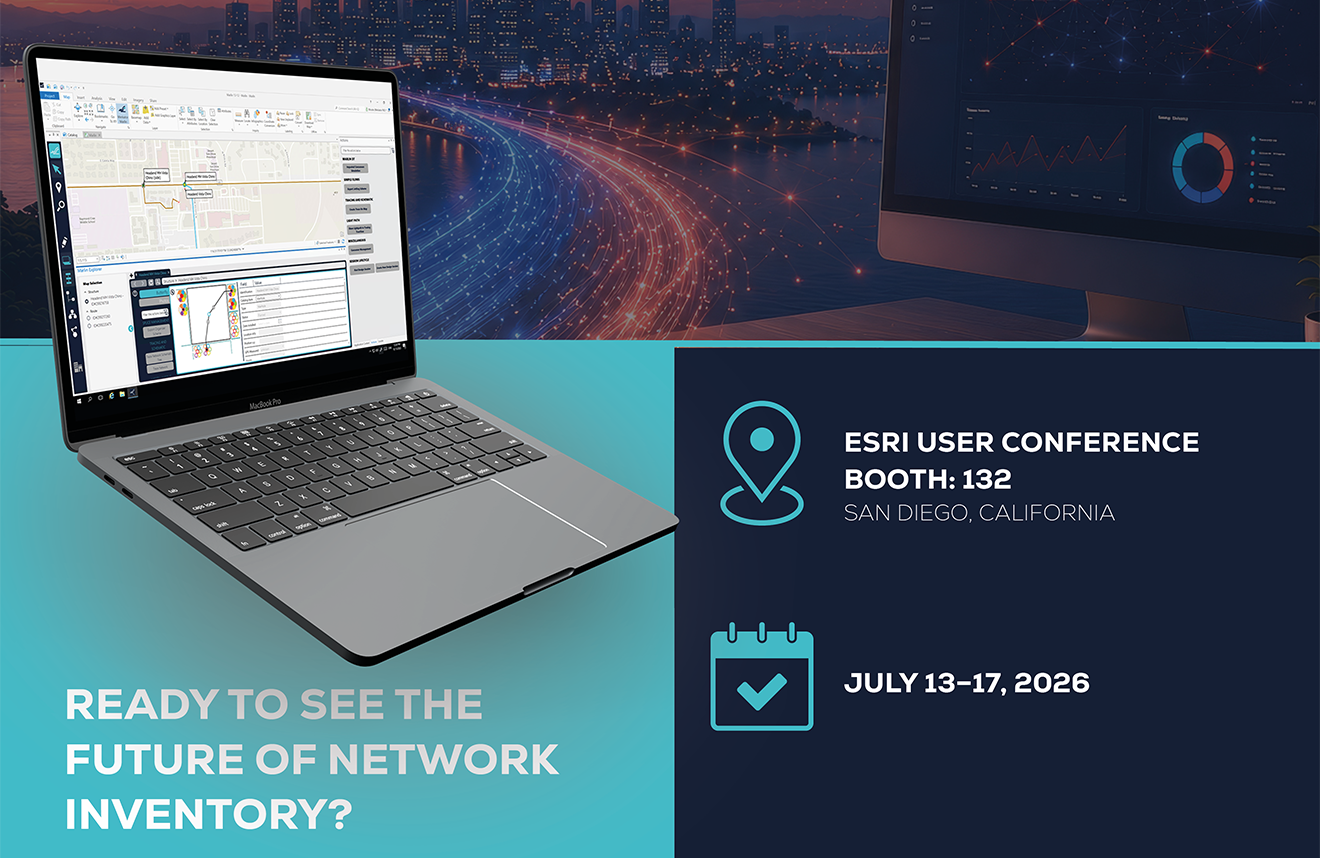
Esri User Conference in San Diego, July 13–17, 2026 — booth 132.

If network inventory is on your mind — whether that’s data quality, migration, or operating a true digital twin — come find us. We’d rather talk about your specific challenge than give you another demo.